In today's society people are paying increasing attention to toxic and harmful substances that affect health, and formaldehyde has become one of the main focal points because of its strong carcinogenicity and the growing number of reported cases. China has therefore established a series of strict formaldehyde limit standards to protect public health. This article reviews these standards: which materials have their formaldehyde content controlled, what the limits are, and what test methods are used.

Before listing them, two concepts need to be clarified: free formaldehyde content and formaldehyde emission. Free formaldehyde content is the total content of monomolecular formaldehyde present in the free state in a material plus that which is easily hydrolysed to formaldehyde. Formaldehyde emission is the amount of formaldehyde a material can release under specified conditions. The former is mainly applied to the control of raw materials or to materials that release formaldehyde completely, while the latter applies to products that release it continuously.
1. Standards using free formaldehyde content as the test target
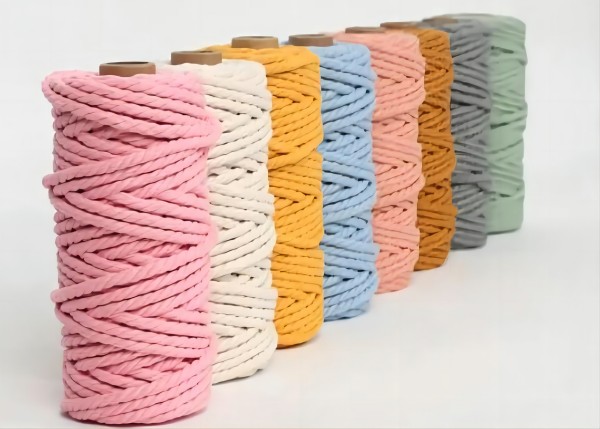
1. GB 18401-2010 applies to textile products for clothing, decoration and household use produced and sold within China. It is divided into three classes: A, B and C.

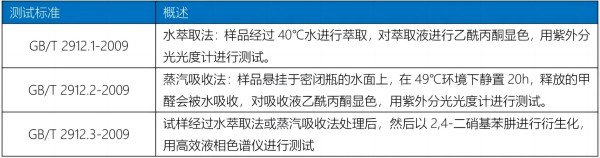
Three test methods are recommended:
2. GB 18583-2008 applies to adhesives for indoor building decoration. These adhesives are divided into three types: solvent-based, water-based and bulk. There is no formaldehyde requirement for bulk adhesives. For solvent-based adhesives, the limit for chloroprene rubber adhesives and SBS adhesives is 500 mg/kg or less. Among water-based adhesives only polyurethane adhesives are exempt; the limit for all other types is 1000 mg/kg or less. Annex A specifies the test method for free formaldehyde: the sample is dissolved in an aqueous solution, the formaldehyde is distilled out, colour is developed with acetylacetone reagent and the result is measured with an ultraviolet spectrophotometer.
3. GB 31040-2014 applies to concrete admixtures for buildings with indoor use functions, with a limit of 500 mg/kg or less. The test method is basically the same as that for adhesives.
2. Standards using formaldehyde emission as the test target
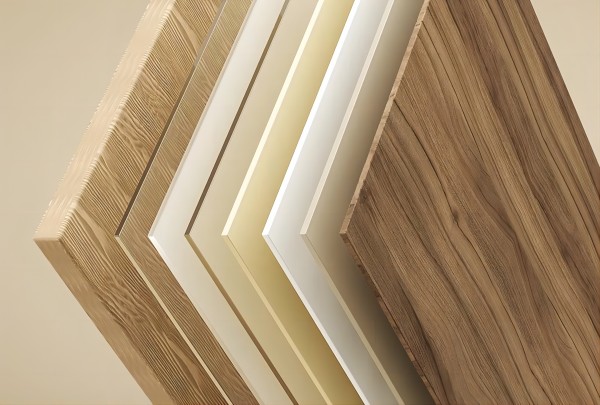
1. GB 18580-2017 applies to wood-based panels and their products used in indoor decoration materials, such as fibreboard, particleboard, plywood, blockboard, reconstituted decorative panels, laminated veneer lumber, glued laminated timber, faced wood-based panels, wooden flooring, wooden wall panels and wooden doors and windows. The limit is 0.124 mg/m3 or less. The test method is the climate chamber method: a sample of specified surface area is placed in a climate chamber at specified temperature, relative humidity, air velocity and air exchange rate, and the formaldehyde released by the sample mixes with the chamber air until the concentration reaches a steady state. A volume of air is then drawn off, the formaldehyde is absorbed in water, colour is developed with acetylacetone reagent and the result is measured with an ultraviolet spectrophotometer.
2. GB 27630-2011 applies to new cars offered for sale. The standard limits harmful gases in the vehicle interior, with a formaldehyde limit of 0.10 mg/m3 or less. The test method is to place the vehicle in a sampling environment chamber at specified temperature and humidity, close all doors and windows and leave it for 16 hours, then sample the interior air using a silica gel packed column coated with DNPH. The target substance reacts with DNPH to form a hydrazone derivative, which is analysed with a high performance liquid chromatograph.
3. Summary
· The formaldehyde test methods make use of two properties of formaldehyde: it is readily absorbed by water and it is strongly volatile at high temperature.
· For textiles, it is still advisable to keep the habit of soaking new clothes in warm water and drying them before wearing, which can effectively reduce the possible impact of formaldehyde and other harmful substances on health.
· When choosing indoor decoration materials, note that boards and adhesives are high-risk formaldehyde materials, so choose reputable and safe brands where possible.
· For new cars and cars that have not been used for a long time, ventilate before starting to reduce the concentration of harmful substances in the cabin.









 WeChat Official Account
 Submit successfully