On 24 July 2026 the EU officially published in the Official Journal the much-anticipated Regulation (EU) 2026/1738 on circular design and end-of-life vehicle management. It marks the European automotive industry's move from end-of-pipe treatment into full life-cycle circular control. The regulation applies from 13 August 2026 and becomes enforceable on 1 September 2028. For the global automotive supply chain, and in particular manufacturers of automotive electronics, semiconductors, displays and polymer materials, an industrial upgrade around circularity and compliance capability has begun.
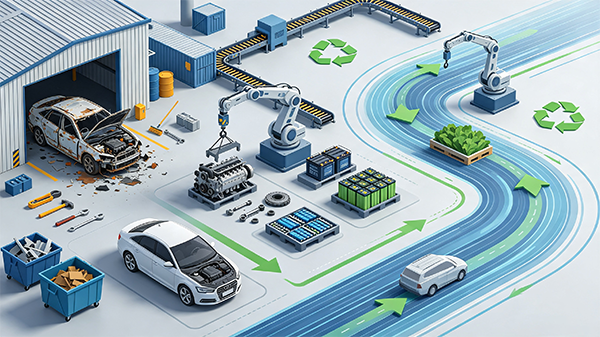
Scope expands step by step from passenger cars to all vehicles
The new regulation breaks with the old ELV Directive's focus on M1 (passenger cars) and N1 (light commercial vehicles) and sets a clear vehicle expansion timetable:
From 1 September 2029: special-purpose M1 and N1 vehicles come into scope.
From 1 September 2031: all vehicle categories are covered, including M2 and M3 (buses and coaches), N2 and N3 (heavy trucks), O category (trailers) and some L category vehicles (two-, three- and light four-wheelers).
In practice, almost every type of road vehicle and its components will face conformity review under the new rules.
Hazardous substances: overlapping regimes, tighter battery requirements
The new ELV regulation retains the existing bans and exemption list for lead, mercury, cadmium and hexavalent chromium, and stresses coherence with the EU REACH and POPs regulations, forming a denser control net for hazardous substances.
Of particular note, Annex XII amends Annex I of the EU Batteries Regulation (EU) 2023/1542 and raises the bar for hazardous substances in vehicle batteries. For batteries installed in vehicles, including special-purpose vehicles, the key limits are:
· Mercury: content of 0.0005% or less (all batteries).
· Cadmium: 0.01% or less by weight in homogeneous materials for electric vehicle batteries and SLI (starting, lighting and ignition) batteries; 0.002% or less for portable batteries, including those incorporated into appliances.
· Lead: 0.1% or less in homogeneous materials for portable batteries used in vehicles; 0.1% or less for electric vehicle batteries; 0.1% or less for SLI batteries (specific transitional exemptions apply to each case).
· Hexavalent chromium: 0.1% or less in homogeneous materials of vehicle batteries.
The regulation specifically notes that batteries used in high-voltage systems (DC voltage above 75 V) must strictly follow the lead exemption deadlines above.
Mandatory recycled content: plastics first, metals to follow
The new rules set explicit recycled content targets for vehicles, marking a shift from encouragement to obligation:
Plastics: from 1 September 2032, post-consumer recycled plastic must account for at least 15% of plastics in new vehicle types; by 1 September 2036 the share rises to 25%. At least 20% of that must come from end-of-life vehicles or from plastic removed during vehicle servicing.
The European Commission will subsequently adopt delegated acts setting recycled content requirements for steel, aluminium, magnesium and rare-earth permanent magnets, together with the corresponding calculation and verification methods.
Systematic compliance: from materials to design, from passport to responsibility
Beyond material and recycled content targets, the regulation builds a broader institutional framework:
Design for dismantling: structural design requirements for repairability and dismantling of key parts such as batteries and electric drive systems, to support resource recovery at end of life.
Digital Circular Vehicle Passport (DCVP): a life-cycle digital information carrier that makes material composition, repair history and recycling treatment transparent and traceable.
Extended producer responsibility (EPR): strengthens the environmental responsibility of vehicle and component producers across the full product life cycle.
Looking ahead
Regulation (EU) 2026/1738 redefines the environmental threshold for automotive products at strategic level. For Chinese companies deeply embedded in the global automotive supply chain, the first task is to screen and upgrade material composition, supply chain information management and recyclable design against the new timetable. Only forward-looking planning secures the initiative in this green compliance test.









 WeChat Official Account
 Submit successfully