On 27 September 2023, the European Commission approved and published Regulation (EU) 2023/2055, which adds a new restriction entry, entry 78, to Annex XVII of the EU REACH Regulation (EC) No 1907/2006 to restrict synthetic polymer microparticles (SPM), also known as microplastics, in various uses, unless exempted. The amendment applies from 17 October 2023 (except for specific products with transition periods).

Restriction and transition periods
Under the regulation, synthetic polymer microparticles may not be placed on the EU market as substances, nor placed on the EU market in mixtures at a concentration of 0.01% or more by weight, where they are present to confer a sought-after characteristic on the mixture.
The regulation grants transition periods for synthetic polymer microparticles in specific products, such as cosmetics, detergents, waxes, polishes, air care products, medical devices, agricultural and horticultural products, and infill material on artificial sports surfaces:
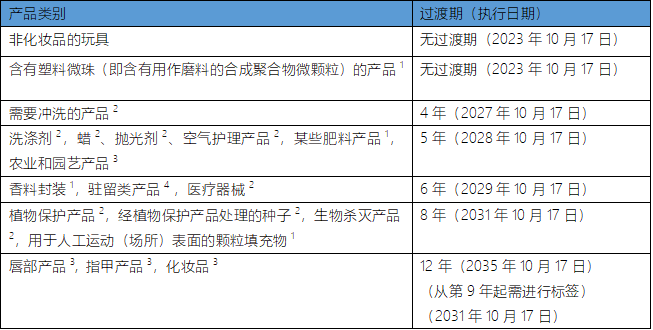
Note: where a product falls into more than one product category, the transition period of the product category with the lowest number applies.
Exemptions
1. The limit does not apply to synthetic polymer microparticles that:
a. are contained by technical means so as to prevent releases into the environment when used as intended in accordance with the instructions for use (for example chromatography columns, water filter cartridges and printer toner);
b. have their physical properties permanently changed during the intended end use so that the polymer no longer falls within the scope of this restriction entry (for example nappies, nail polish and paints);
c. are permanently incorporated into a solid matrix during the intended end use (for example fibres added to concrete and granules used as raw material for moulded articles).
From 2027, suppliers of products containing synthetic polymer microparticles as described in points (a), (b) or (c) of paragraph 1 that are first placed on the EU market for professional users and the general public must notify ECHA by 31 May each year.
2. The restriction also does not apply to the following situations and products:
a. synthetic polymer microparticles used at industrial sites, as substances or in mixtures (subject to specific conditions);
b. medicinal products within the scope of Directive 2001/83/EC and veterinary medicinal products within the scope of Regulation (EU) 2019/6;
c. EU fertilising products within the scope of Regulation (EU) 2019/1009;
d. food additives within the scope of Regulation (EC) No 1333/2008 (subject to specific conditions);
e. in vitro diagnostic devices, including devices within the scope of Regulation (EU) 2017/746 (subject to specific conditions);
f. food within the meaning of Article 2 of Regulation (EC) No 178/2002 that is not covered by point (d) above, and feed as defined in Article 3(4) of that Regulation;
g. synthetic polymer microparticles placed on the EU market before 17 October 2023 and not used in the products subject to the transition periods above.
From 2027, suppliers of products containing synthetic polymer microparticles as described in points (b), (d) or (e) of paragraph 2 that are first placed on the EU market for professional users and the general public must notify ECHA by 31 May each year.
About microplastics
The concept of microplastics was first proposed in a 2004 paper by Thompson and colleagues at the University of Plymouth in the United Kingdom on plastic fragments in marine waters and sediments, referring to plastic fragments and particles less than 5 mm in diameter. In practice, microplastics range in size from a few micrometres to several millimetres and are heterogeneous mixtures of plastic particles of various shapes. There are two main sources: primary microplastics, which are plastic microbeads already smaller than 5 mm when produced and are often used in cleansing toiletries and cosmetics; and secondary microplastics, which are tiny particles ultimately formed from larger plastics through physical, chemical and biological action and are chemically basically identical to plastic products.
Compared with "white pollution" plastics, microplastics are small in size and have a large specific surface area, making them more likely to adsorb pollutants and act as carriers, so their harm to the environment is deeper. They are now ranked alongside persistent organic pollutants, endocrine disruptors and antibiotics as four major classes of new pollutants. In recent years many countries have introduced restrictions on microplastics. For example, in 2021 China's National Development and Reform Commission and the Ministry of Ecology and Environment published the Action Plan for Plastic Pollution Control during the 14th Five-Year Plan, requiring a ban on certain products harmful to the environment and human health, such as daily chemical products containing plastic microbeads. The EU microplastics restriction is expected to reduce microplastic pollution in the EU by 70% and cut a cumulative 500,000 tonnes of microplastic waste over the next 20 years, strongly advancing global efforts to tackle microplastics.








 WeChat Official Account
 Submit successfully